
Material Hoist: The Smart Vertical Lifting Solution for Modern Construction Projects
Table of Contents
- What is a Material Hoist?
- Why Material Hoists Matter in Construction
- P CUBE Material Hoist: Built for Heavy-Duty Site Performance
- Key Features of P CUBE Material Hoist
- Applications of Material Hoists in Construction Projects
- Material Hoist vs Conventional Lifting Methods
- Safety, Compliance and Operational Reliability
- Why Choose P CUBE Material Hoist
- Frequently Asked Questions
- Conclusion
Material Hoist: The Smarter Way to Lift, Move and Build Faster
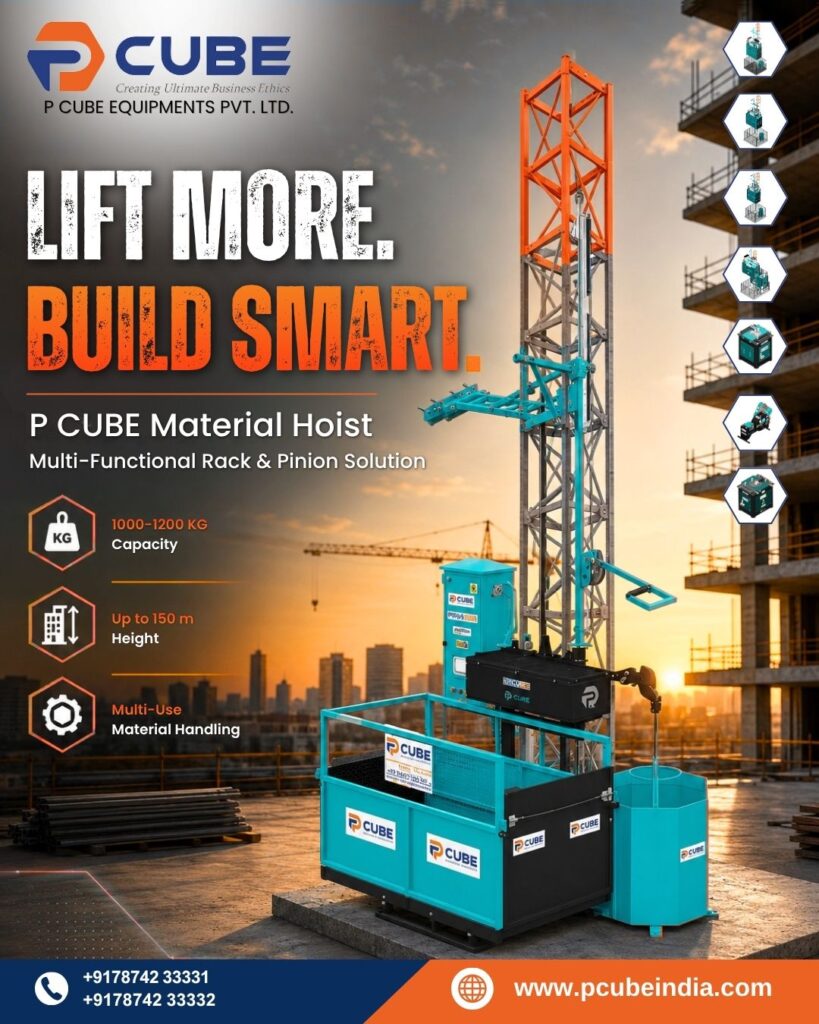
A Material Hoist is no longer just an optional construction machine for large projects. It has become a practical requirement for builders, contractors, infrastructure companies, developers, and industrial project managers who need a safer and faster method of moving materials vertically across multiple floors. On active construction sites, time, safety, labour productivity, and material movement directly affect project cost and completion schedules. That is exactly where a high-performance Material Hoist delivers measurable value.
In today’s construction environment, moving bricks, cement bags, steel sections, shuttering material, tools, concrete buckets, and site supplies manually or with inefficient lifting methods can slow down work, increase labour dependency, and create safety risks. A properly designed Material Hoist helps solve these problems by creating a dependable vertical transport system for materials. It improves speed, reduces handling fatigue, supports safer site movement, and helps project teams maintain continuity between ground operations and upper floors.
The P CUBE Material Hoist is designed as a multi-functional rack and pinion solution for construction material lifting. It is built to support demanding site conditions where reliability, strength, and controlled lifting are critical. As shown in the product specifications, P CUBE’s hoist platform is intended to deliver high lifting performance for material handling on construction sites, especially where consistent vertical movement is needed throughout the project lifecycle. The P CUBE rack-and-pinion tower hoist is offered in capacities of 1000–1200 kg net load, with lifting heights reaching around 120 m, along with multiple safety and handling features for construction use.
What is a Material Hoist?
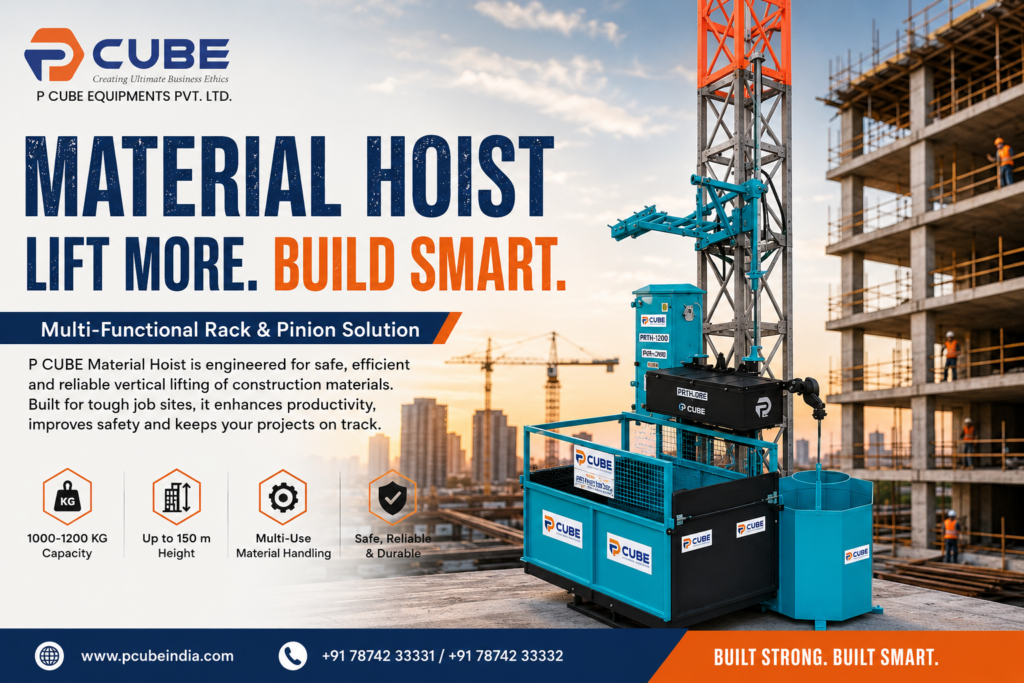
A Material Hoist is a mechanical lifting system used to move construction materials vertically from one level to another on a building site. Unlike passenger lifts, a material hoist is primarily engineered to transport goods, equipment, tools, concrete, steel bars, formwork components, and other construction loads between floors or work zones. It helps streamline site logistics, particularly in mid-rise and high-rise construction, where vertical movement becomes one of the biggest operational challenges.
On conventional sites, materials are often shifted using cranes, manual labour, temporary pulley systems, or fragmented lifting arrangements. While those methods may work in limited situations, they are not always efficient for repeated and controlled daily movement of materials. A dedicated Material Hoist gives the project a structured lifting mechanism that can be used repeatedly with better control, higher consistency, and improved safety. This is especially useful when multiple trades are working simultaneously, and each floor requires a steady supply of materials.
The biggest advantage of a Material Hoist is that it converts vertical transportation into an organised site process rather than a daily bottleneck. Instead of depending entirely on cranes for every material movement, project teams can allocate the hoist for regular lifting cycles, reduce idle time, and keep construction progress more predictable.
Why Material Hoists Matter in Construction
Construction productivity is often limited not by lack of manpower but by the inefficiency of moving material from the ground to the point of use. On a multi-storey project, workers may be ready, concrete work may be scheduled, masonry may be ongoing, and steel fixing may be in progress, but if the material does not reach the floor on time, productivity collapses. A Material Hoist directly addresses this challenge.
When builders invest in a high-quality Material Hoist, they reduce the delay between material arrival and material use. This matters because every delay on a site creates a chain reaction. Labour teams wait, supervisors adjust schedules, equipment stands idle, and deadlines slip. By introducing a structured lifting system, material flow becomes more predictable. That predictability helps with project planning, floor-by-floor coordination, and labour deployment.
A Material Hoist also supports safer handling. Construction materials are often bulky, uneven, sharp-edged, heavy, or difficult to balance. Repeated manual lifting increases the risk of fatigue, injuries, and accidental drops. A hoist provides controlled vertical movement, which reduces manual strain and supports a more disciplined work environment. On projects with repeated daily lifting needs, the value of a hoist becomes even more visible because it saves time on every cycle, every day, across the full duration of the build.
P CUBE Material Hoist: Built for Heavy-Duty Site Performance
The P CUBE Material Hoist is positioned as a practical construction lifting solution for projects that need durability, controlled lifting, and versatile site use. The product is designed as a multi-functional rack and pinion hoist, allowing it to handle more than one type of material movement requirement. Based on P CUBE’s published specifications, the hoist is suitable for transporting construction material, TMT bars, and even concrete through optional accessories such as a tilting concrete bucket. The hoist models are designed with 1000 kg and 1200 kg net load capacities, approximately 30 m/min lifting speed, and up to 120 m lifting height, depending on model and site configuration.
This matters because construction sites rarely have a single type of lifting requirement. One day the need may be steel bars and scaffolding material, while the next day it may be masonry supplies, finishing material, tools, or concrete-related accessories. A multi-functional Material Hoist gives project teams more flexibility without needing multiple dedicated lifting systems for each task.
The machine is also designed for rugged construction environments where equipment is exposed to dust, vibration, changing weather, repetitive loading cycles, and continuous use. In such conditions, reliability is not a bonus feature; it is a requirement. A hoist that performs consistently under site pressure helps avoid costly stoppages and reduces dependency on improvised lifting arrangements.
For companies handling commercial buildings, residential towers, industrial facilities, warehousing structures, and infrastructure works, the P CUBE Material Hoist can serve as a central lifting solution that supports progress from structural work to finishing phases.
Key Features of P CUBE Material Hoist
1) Strong Load Capacity for Construction Materials
One of the first things contractors evaluate in a Material Hoist is lifting capacity. The P CUBE hoist is designed for 1000–1200 kg net load capacity depending on model configuration, which makes it suitable for a broad range of construction materials and site equipment.
2) Impressive Height for Multi-Storey Projects
Vertical reach is critical in modern building construction. P CUBE’s published specifications indicate hoist height capability of around 120 m, while the promotional material highlights high-rise application suitability. This makes the system relevant for multi-storey and high-rise developments where manual movement is impractical.
3) Rack and Pinion Technology for Controlled Lifting
Rack and pinion systems are widely preferred in construction hoists because they support stable and controlled vertical travel. This mechanism helps improve lifting consistency and reduces dependence on improvised methods. For projects that need repeated lifting cycles through the day, this can improve both site rhythm and handling confidence.
4) Multi-Use Functionality
The P CUBE Material Hoist is promoted as a multi-functional unit capable of handling construction material, TMT bars, and concrete-related site lifting applications through optional attachments and accessories. That flexibility makes it useful for builders who want one lifting solution to serve multiple work stages.
5) Safety-Oriented Design
The P CUBE specification mentions several safety-oriented features such as brake motor arrangement, top and bottom limit switches, emergency stop controls, and safety device mechanisms. It also references compliance alignment with IS 12466:2012 for hoist-related safety and performance requirements.
6) Site-Friendly Optional Attachments
A major advantage of the P-CUBE system is its ability to adapt to different site tasks. Optional features listed by the manufacturer include concrete bucket, rebar carrier, erection crane, floor selection, and load cell options. This increases the operational range of the hoist and makes it more useful across different phases of construction.
Applications of Material Hoists in Construction Projects
A Material Hoist is valuable because it serves a wide range of practical applications across construction and industrial projects. On high-rise residential and commercial buildings, it can be used for the daily movement of cement bags, blocks, steel sections, tiles, tools, electrical supplies, plumbing material, and finishing products. Instead of relying on inconsistent manual movement, teams can create a dedicated lifting schedule using the hoist.
On industrial projects and warehouse developments, the hoist supports vertical movement of fabrication material, equipment components, maintenance tools, and installation supplies. On infrastructure and institutional projects, it helps maintain workflow when materials need to reach multiple levels quickly and repeatedly.
A particularly useful application is the movement of TMT bars and concrete-related materials. Since the P CUBE system is designed as a multi-functional hoist, it supports the operational reality of Indian construction sites, where lifting requirements change by stage. During structural work, steel and shuttering may dominate. During masonry, block and cement movement becomes more important. During finishing, tiles, fittings, paint materials, and tools need to move continuously. A versatile Material Hoist is therefore not just a lifting machine; it becomes a site productivity asset.
Material Hoist vs Conventional Lifting Methods
Many construction sites still rely heavily on tower cranes, temporary winches, labour-intensive shifting, or ad hoc pulley arrangements for material movement. While those methods may still have a role, they are not always ideal for repetitive daily vertical transport. A Material Hoist fills that gap by providing a dedicated, repeatable, and site-focused lifting solution.
A crane is excellent for major lifts and structural operations, but using it for every small and medium material movement can create inefficiency and scheduling conflicts. Labour-based lifting may appear cheaper in the short term, but it often introduces delays, fatigue, inconsistency, and safety risk. Temporary lifting setups may solve an immediate problem, but they do not offer the same level of structured performance as a purpose-built hoist.
A Material Hoist creates a predictable vertical supply line. That improves planning. It reduces wait time for floor teams. It helps maintain material availability where it is needed. Over the life of a project, these operational gains can significantly outweigh the initial investment in proper lifting equipment.
Safety, Compliance and Operational Reliability
Safety should never be treated as a secondary consideration in vertical lifting. Material handling accidents on construction sites can lead to injuries, downtime, damaged material, project delays, and regulatory complications. That is why selecting a Material Hoist with proper safety features and alignment with recognised standards matters.
PCUBE’s published material states that its tower hoist is designed in line with IS 12466:2012, which addresses requirements related to construction hoists, including aspects of capacity, construction, performance, and testing. In addition, the manufacturer mentions features such as emergency stop controls, top and bottom limit switches, brake motor systems, and safety device arrangements intended to enhance operational control.
Construction companies should also stay aligned with broader site safety and building practice frameworks. India’s National Building Code provides guidance related to building construction practices and safety, while the Ministry of Labour & Employment provides industrial safety and workplace safety resources for employers and project stakeholders.
For reference, you can review:
- National Building Code information by BIS
- Industrial Safety and Health resources by Ministry of Labour & Employment
Including such references in project planning is useful not just for compliance thinking, but also for creating a safer operating culture around lifting, loading, operator training, and maintenance.
Why Choose P CUBE Material Hoist
1. Built for Real Construction Conditions
The P CUBE Material Hoist is designed for real-world site usage, not theoretical performance alone. Construction sites demand equipment that can withstand repetitive loading, harsh outdoor conditions, and continuous operation. A hoist that performs reliably in such an environment directly supports project continuity.
2. Multi-Functional Material Handling
One of the strongest reasons to choose P CUBE is versatility. The hoist is not limited to one narrow application. It can support construction materials, TMT bars, and optional concrete handling arrangements, which makes it suitable for multiple stages of the project.
3. Useful Capacity and Height Range
With 1000–1200 kg net capacity and high lifting range, the P CUBE hoist is positioned well for medium to large construction projects where consistent vertical transport is essential.
4. Safety-Focused Engineering
Safety features, brake arrangements, switches, and standards-oriented design all matter when evaluating a Material Hoist. P CUBE’s product documentation reflects a clear focus on safe operation and controlled lifting.
5. Productivity Gains Across the Project Lifecycle
A hoist is not only about lifting. It is about reducing delay, improving material availability, and helping every trade on the project stay productive. From structure to finishing, a dependable Material Hoist can contribute to smoother site execution.
6. Suitable for Builders, Contractors and Developers
Whether the requirement is for residential towers, commercial projects, industrial structures, or infrastructure-related construction, P CUBE’s hoist can be positioned as a reliable vertical lifting partner for demanding project environments.
If you want to explore P CUBE’s construction equipment range, you can direct readers to the company website here: P Cube Equipment Pvt. Ltd
FAQs – Material Hoist
1. What is a Material Hoist used for in construction?
A Material Hoist is used to lift and move construction materials such as cement, steel, blocks, tools, concrete buckets, and other supplies between different floors of a building site safely and efficiently.
2. What is the lifting capacity of the P CUBE Material Hoist?
According to P CUBE’s published specifications, the hoist is available in configurations with 1000 kg to 1200 kg net load capacity, depending on model selection.
3. Can the P-CUBE Material Hoist be used for TMT bars and concrete handling?
Yes. P CUBE presents its hoist as a multi-functional material hoist that can be used for transporting construction materials, TMT bars, and concrete-related lifting through optional accessories.
4. What type of technology is used in the PCUBE Material Hoist?
The featured hoist is designed as a rack-and-pinion material hoist, a system widely used for controlled vertical lifting in construction projects.
5. Is the P-CUBE Material Hoist suitable for high-rise projects?
Yes. Based on available specifications, the hoist is designed for substantial lifting heights and is suitable for multi-storey and high-rise construction applications.
6. Why should builders invest in a Material Hoist instead of relying only on labour or cranes?
A Material Hoist provides consistent vertical transport, reduces manual handling, improves safety, saves time, and helps maintain workflow across floors. It is especially valuable when a project has frequent daily lifting needs.
Conclusion
A Material Hoist is one of the most practical investments for modern construction sites that need speed, safety, and reliable vertical material movement. As buildings become taller and project timelines become tighter, contractors cannot afford inefficient material flow. Delays in lifting materials affect labour productivity, floor readiness, and project schedules. That is why the right hoist system can create a direct operational advantage.
The P CUBE Material Hoist stands out as a smart construction lifting solution because it combines site-focused capacity, multi-functional use, substantial height capability, and safety-oriented design. For builders and contractors looking to improve material handling on residential, commercial, or industrial projects, a robust Material Hoist from P CUBE can support faster execution and better site control.
If your goal is to improve productivity, reduce lifting delays, and create a more organised construction workflow, investing in a dependable Material Hoist is a strategic move—and P CUBE offers a solution designed around those exact site needs.

